Private label honeycomb paper: how to brief the carton and roll labels
Brief private label honeycomb paper cartons and roll labels: what each panel needs, flat vs expanded length, barcodes, origin marking and FSC rules.
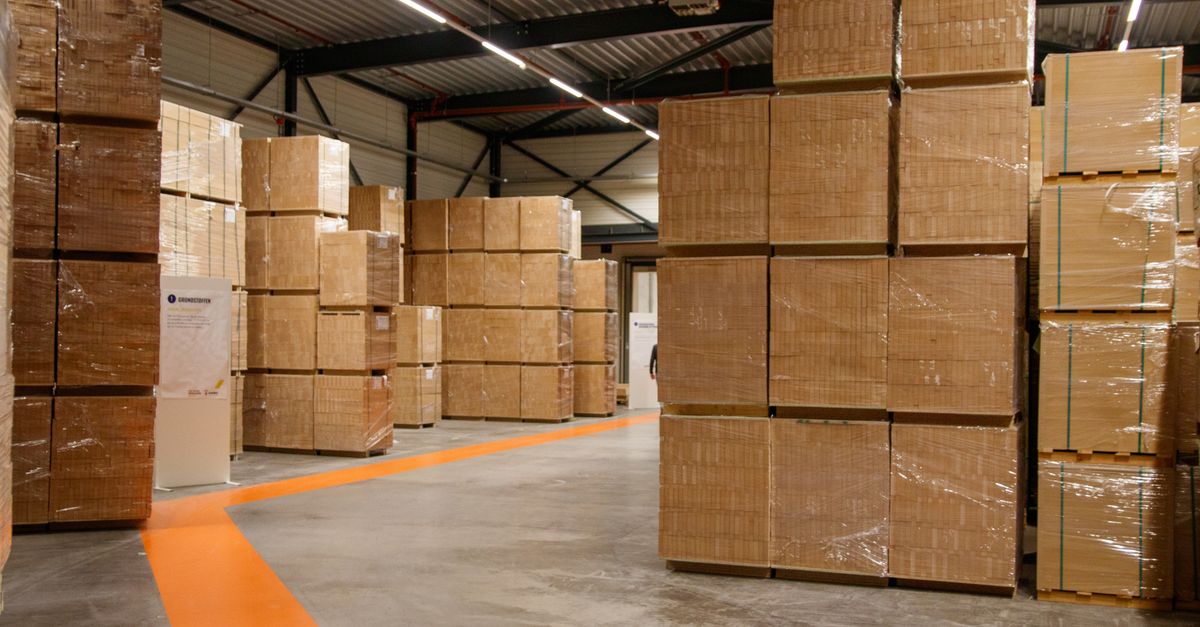
A private label carton for honeycomb paper needs three things designed: the outer carton, the label on the roll or its core, and the pallet label. Each one serves a different reader. The carton sells your brand and tells your warehouse what is inside. The roll label helps the end user and traces the lot. The pallet label gets the goods through ports and receiving bays.
Brief all three together, state the flat length first, put your own codes and barcodes on, and check the proof slowly. A mistake on the artwork is printed on every carton in the container.
Some of the honeycomb paper we make in Jaipur leaves in another company's cartons. A UK packaging distributor, for example, sells our rolls under its own brand and its own product codes. So we have been through this brief from the supplier's side, and the lessons below apply to almost any private label range.
What goes on the outer carton?
Think of the carton as four or five panels, each with one job. A typical layout looks like this.
| Panel | What goes on it | Who reads it |
|---|---|---|
| Brand panel (largest side) | Your logo, product name, one line on what it is, a product photo or drawing | The buyer, in a shop or on a pallet |
| Specification panel | Width, flat length, GSM, colour, rolls per carton, your SKU code | Your warehouse and your customer's purchasing team |
| Code panel | ITF-14 barcode, SKU, lot number, "Made in India" | Scanners, receiving staff, customs |
| End panel | SKU and short description again, in large type | Anyone picking from a stacked shelf where only the ends show |
| Handling marks | Keep dry, this way up | Forklift drivers and warehouse handlers |
Handling marks come from a recognised set. ISO 780:2015 is the international standard for handling and storage symbols on distribution packages. "Keep dry" is the one that matters most for paper.
The end panel is the one designers forget. In a warehouse, cartons are stacked with only the ends visible. If the end panel is blank, someone has to pull the carton out to read it.
How should you describe the length?
State the flat length first, every time. For example: "Width 380 mm. Length 250 m (flat, unexpanded)."
If you want to show the expanded length, put it second and say "about". With our cut, the paper expands about 1.6 times, so a 250 m flat roll gives roughly 400 m of wrap. On a carton that reads: "250 m flat, about 400 m when expanded".
I would never print the expanded figure alone. Expansion depends on the cut pattern and on how hard each packer pulls. A customer who measures 370 m and reads "400 m" on the box will feel cheated, even though nothing is wrong with the paper. The flat length is the only figure anyone can check with a scale.
Our guide to writing a bulk purchase order explains why we quote everything flat.
Barcodes and product codes
Use your own codes. That is the point of private label: your warehouse system should be able to receive the cartons without relabelling.
- SKU. Your product code, printed on the specification, code and end panels.
- GTIN. The global trade item number, from your own GS1 company prefix, because the product carries your brand.
- Barcode type. For outer cases that are not scanned at a retail checkout, GS1 uses the ITF-14 symbol. GS1's own support page explains when ITF-14 barcodes can be used. It is designed to print well on corrugated board.
- Lot number. We check every lot for GSM, roll weight, moisture and cut quality. A lot number on each carton means any question can be traced back to that lot.
Send us the barcode numbers, and ideally the barcode artwork itself. Then scan a printed proof with your own warehouse scanner before you approve it.
I should be clear about our limit here. We print the codes you send us. We cannot know that a digit in your spreadsheet is wrong, so the scan test on your side is the real safeguard.
Country of origin
Put "Made in India" on the carton. Most import markets expect the origin to be shown, and some require it in a specific way.
For the United States, the federal rules in 19 CFR Part 134 require imported goods to be marked with the English name of the country of origin, as legibly, indelibly and permanently as the article allows. How that applies to rolls packed in cartons is a question for your customs broker, and I would ask it before the artwork is final.
For other markets, ask your own customs adviser. I would still print the origin on every carton, because it costs nothing and removes a question at the border.
Can the carton carry an FSC label?
This is the question I would settle before any artwork is drawn.
FSC has strict rules for its trademarks. The current standard, FSC-STD-50-001 V2-1, requires the certificate holder's trademark licence code with every use of the FSC trademarks, and labels are approved through the certification body. Our certificate is SGSHK-COC-400324, and our licence code is FSC-C193292.
Two points matter for private label:
- An FSC claim reaches your customer only through the invoice chain. If you sell the rolls on with an FSC claim, you usually need your own chain of custody certificate.
- The FSC label on a carton must match the claim on the product inside. Our usual claim on honeycomb paper is FSC Recycled.
So if FSC on the carton matters to you, tell us early, and speak to your own certification body at the same time. Our quality page has our certificate details.
The roll label and the pallet label
The core itself can carry your brand too. We print and colour cores to order, so your name stays visible on every roll until the last metre is used.
The roll label is small, but useful. A sticker inside the core, or on the roll wrapper, with your SKU, width, flat length, GSM and lot number helps the end user reorder the right item and helps you trace a complaint.
The pallet label carries your SKU, the quantity of cartons or rolls, the lot number and the destination. Ask your forwarder and your warehouse what they need on it. Some warehouses want a specific label layout or a GS1-128 pallet label.
Approving the proof
Check the proof slowly, and get a second person to check it too. These are the errors I would look for first:
- A barcode number that does not scan, or scans as the wrong product.
- Width in mm on one panel and inches on another, with different values.
- Expanded length shown without the flat length.
- The wrong SKU on the end panel.
- A colour name on the carton that does not match the paper inside.
- An FSC logo added by a designer without a licence code.
Our private label page explains how the whole order runs, from sample to container. Printed cartons are made for your order only, so changes after approval cost time.
Send us your logo, your SKU list and any artwork you already have through the contact page. We will come back with samples, a carton proof and a quote.
Questions buyers ask
Can you print my existing carton artwork?
Yes. Send it as print-ready files, with your codes and barcodes already in place. We can also prepare a design from your logo and brand colours for you to approve. Either way, you approve the final proof in writing before printing.
Should the carton show the expanded length?
Only as a secondary figure, and only as an approximation next to the flat length. The flat length is what you can check with a scale. Expansion depends on the cut and on how hard the paper is pulled, so a promise of an exact expanded length invites complaints.
Who provides the barcode numbers?
You do. The GTIN on a private label carton should come from your own GS1 company prefix, because the product is sold under your brand. We print the number and the barcode you give us.
Can my private label cartons carry the FSC logo?
Possibly, but it needs planning before artwork is final. FSC requires a licence code with every use of its trademarks and approval by a certification body. If you resell under an FSC claim, you will usually need your own chain of custody certificate. Ask us and your certification body before you design it in.