Why honeycomb paper expands, and what changes the ratio
What sets the expansion ratio of honeycomb paper: slit pattern, paper stretch, brake and moisture. What our 1.6x means, and how to measure yours.
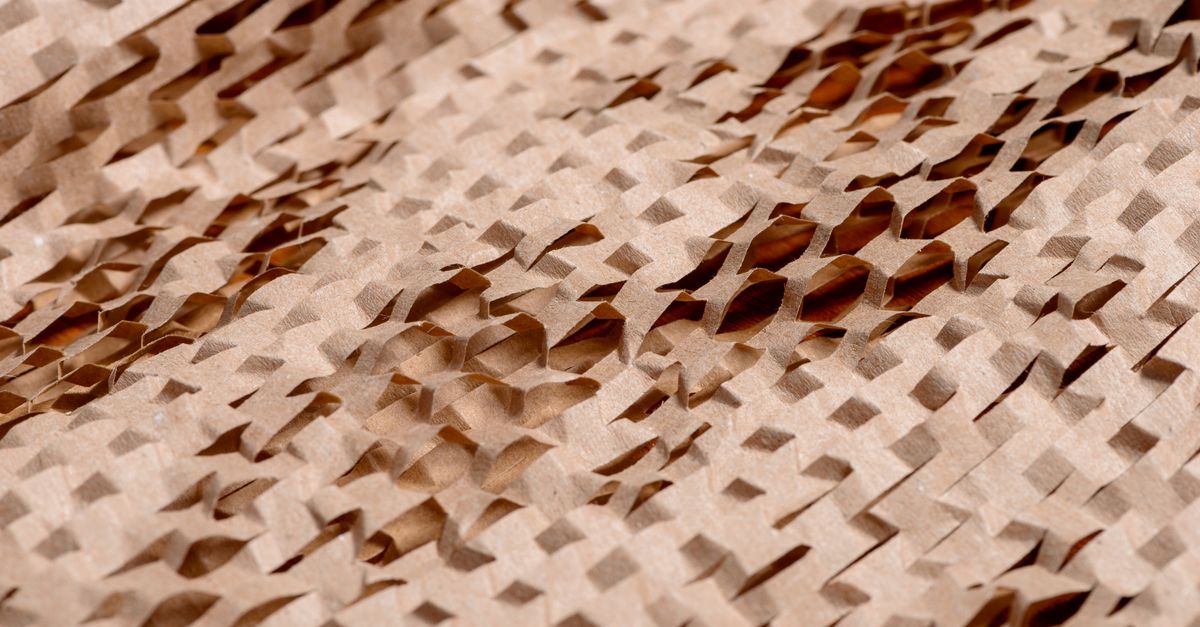
Pull one metre of flat honeycomb paper through a dispenser and you will get more than a metre of wrap. How much more is the expansion ratio. It is one of the most quoted numbers in this trade, and one of the least understood.
The ratio is opened length ÷ flat length. It is set mainly by the slit pattern cut into the paper, i.e. how long the slits are, how much paper is left between them, and how far apart the rows sit. The paper's stretch and stiffness, the dispenser brake, the way your packers pull and the moisture in the paper all move it a little. With our cut, the ratio is about 1.6x, so a 250 m flat roll gives roughly 400 m of wrap.
A bigger ratio is not automatically a better paper.
It only tells you how the cut behaves.
Why does the paper get longer at all?
The cutting die does not remove any paper. It only makes rows of short slits, each row shifted half a step from the last. When you pull, each slit opens into a gap, and the narrow strips of paper between the slits twist up out of the flat sheet.
The length you gain comes from those gaps opening. The sheet also gets narrower, because the opening cells draw the edges inward. A 1997 US patent on slit sheet packing material, US5667871A, puts it in one line: the expanded material "increases in length, decreases in width" and gains cushioning thickness.
What sets the ratio?
The cut sets the range.
Everything else moves the result inside that range.
The same 1997 patent explains that the amount of paper left between slits, and the distance between the rows, decide the angle at which the raised strips stand and the degree of expansion. It describes the strips ideally standing at about 45 to 70 degrees to the sheet. Longer slits with less paper between them let the strips swing further, so the paper can open more.
| What changes | What it does to the ratio | Who controls it |
|---|---|---|
| Slit length versus the paper between slits | Longer slits, less land: more expansion | The paper maker, through the cutting die |
| Spacing between rows | Changes how far each strip can turn | The paper maker |
| The paper's stretch | Paper that stretches before it tears can open further | The paper mill and the paper maker's grade choice |
| Paper weight and stiffness | Stiffer paper needs a firmer pull to open fully | The grade you order |
| Dispenser brake | Too loose: cells half open. Too tight: tears | Your packing room |
| Speed and style of pull | Jerky pulls tear before cells open evenly | Your packers |
| Moisture in the paper | Damp paper loses stiffness and tears sooner | Storage, at both ends |
A later US patent, US11401090B2 (published August 2022), adds the paper side of the story. It describes using kraft with some built-in stretch, so the cells open with a lower pulling force. Paper that can stretch a little before it breaks forgives an uneven pull.
Is a bigger ratio better?
Not by itself. A cut that opens further gives you more metres of wrap per flat metre of paper. That sounds like free paper, and it is easy to sell.
But the paper did not grow. The same grams are now spread over more length. And past the point where the cells are fully open, extra pull does not add useful wrap. It loads the ends of the slits, and the paper tears. The 1997 patent notes the heavy load that falls on the slit ends during expansion.
So when a supplier quotes a big ratio, ask two questions. How thick is the opened wrap? And how much does it narrow? A long, thin, narrow wrap can cover less of your product than a shorter, thicker one.
I would rather quote the ratio a normal packer gets on a normal dispenser.
That is why we say "about 1.6x" and stop there.
Why length alone misleads
Paper gains length and loses width at the same time. So the area it covers grows by less than the length suggests.
Here is an example with made-up round numbers. Say a paper opens to 1.6 times its flat length, and its opened width is 0.85 times its flat width. The area it covers is 1.6 × 0.85 = 1.36 times the flat area, not 1.6 times.
That matters when you compare two rolls. A paper that opens longer but narrows more can cover the same area as a paper with a lower ratio. Measure both directions before you decide one roll is "more economical".
How to measure the ratio properly
Our guide to honeycomb paper consumption shows how to measure length on your line for a stock forecast. For comparing papers, I would go further and record three numbers.
- Mark a flat piece exactly 1 m long, and measure its flat width.
- Pull it open the way your packers do, on your dispenser at your usual brake setting.
- Let go and wait one minute. Some paper springs back a little, and the 1997 patent notes that fibre type affects how much the expanded paper tries to return to its flat form.
- Measure the opened length and the opened width at the middle of the piece.
- Press a ruler lightly onto the opened paper and read its thickness. Do the same on two layers.
- Repeat with two other packers, and take the average.
Write it down like this: length ratio, width ratio, area ratio, single-layer thickness. That gives you four numbers per paper.
Now you can compare any two rolls honestly, whoever manufactured them.
Our ratio, and its limits
With our cut, 1 m of flat paper opens to about 1.6 m. We quote every roll length flat, so our 250 m roll gives roughly 400 m of wrap. Our products page shows the same figures.
I should admit what that number is not. It is not a promise for your dispenser. A tighter brake or a firmer packer will get a little more, a gentle pull will get a little less. Damp paper behaves differently again, which our guide to storage and humidity explains.
If you want to see how the slit pattern itself affects cushioning, our guide to cell size and slit patterns picks up from here.
Ask us for a sample through our contact page, run the six steps above, and send me your four numbers. I would like to know what your packers get.
Questions buyers ask
Can I change the expansion ratio of a roll I already have?
Only a little. The brake and the way your packers pull move it within a narrow band. The cut sets the range, and no brake setting turns a 1.6x cut into a 2x cut without tearing paper.
Why is my opened length shorter than the supplier's figure?
Usually because the supplier measured under a firmer pull, or measured before the paper relaxed. Your dispenser and your packers give your number. Measure it yourself and plan your stock on that, not on a brochure.
Does the ratio stay the same from the start to the end of a roll?
Not always. On a dispenser that brakes the spindle, the pull needed rises as the roll gets smaller, so paper near the end can open further or tear. Check a metre near the end of a roll and adjust the brake if needed.
Do white and coloured papers expand the same as brown kraft?
They can differ, because the base paper is different even at the same GSM. Measure each colour separately if you plan stock on the ratio.