Honeycomb cell size and slit pattern: what it changes for protection
How honeycomb paper's cell size and slit pattern change cushioning, grip and tearing, what the patents say, and a desk method to compare two cut patterns.
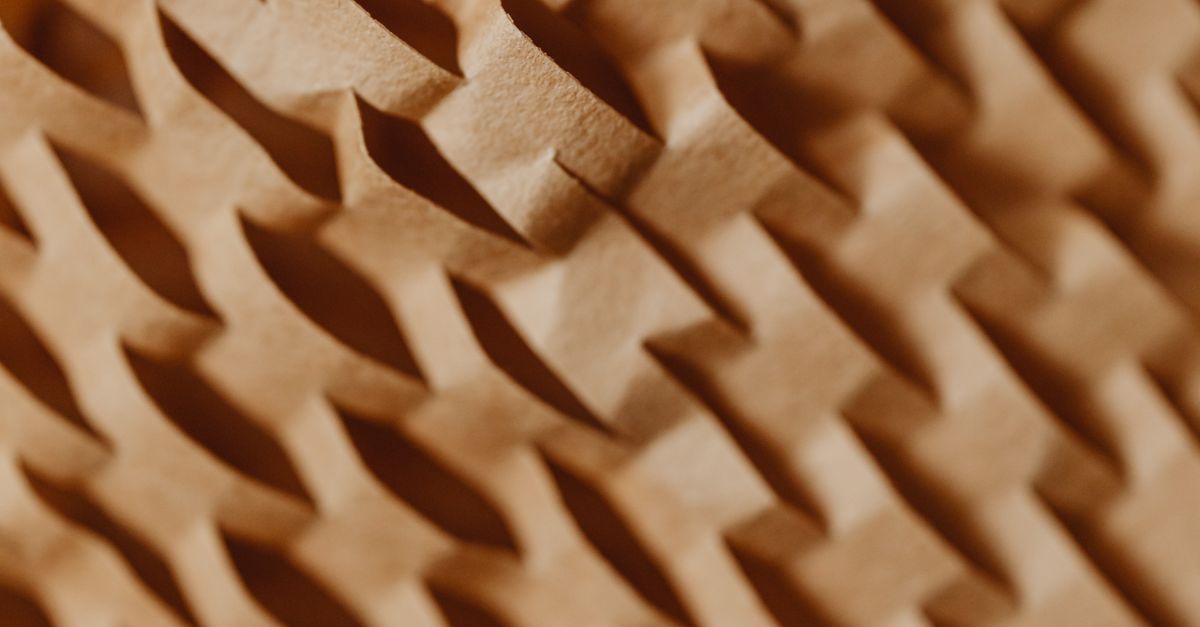
Hold two honeycomb papers side by side and they can look almost the same.
Pull them open and the difference shows. One opens into small, tight cells. The other opens into bigger, looser ones. Both are called honeycomb paper, and both may say 80 GSM on the label.
Cell size is set by the slit pattern: how long the slits are, how much paper is left between them, and how far apart the rows are. Smaller cells mean more cell walls in every square metre, and a 2022 US patent links that to greater crush resistance and resilience. Larger cells open into a looser wrap that covers ground quickly but has fewer walls to take a knock. Cell shape matters too, because upright hexagons hold a load better than flattened diamonds. The only reliable way to choose is to compare two patterns on your own product.
What decides the size of a cell?
Three numbers on the cutting die decide it.
- The slit length, i.e. how long each cut is.
- The land, which is the strip of uncut paper between two slits in the same row.
- The row spacing, which is the distance from one row of slits to the next.
When the paper is pulled, each slit opens into a cell. A long slit opens into a big cell. Close rows make narrow strips of paper, which form thin, closely packed cell walls.
You can measure all three on a flat sample with a steel ruler. Do it before you pull the paper open, because the cells change shape as they open.
What do the patents say about small and large cells?
Most of the published detail on honeycomb cuts sits in patents, not in textbooks.
We read them the way any manufacturer reads a competitor's drawings: carefully, and with some suspicion. Two are worth reading if you are writing a specification.
A 1997 US patent, US5667871A, describes a pattern of half-inch slits, 3/16 inch apart, with rows 1/8 inch apart, cut into paper about 0.008 inch thick. It reports that this opened to roughly 20 times the thickness of the flat paper. It also explains that, with the right proportions, the cells open as hexagons rather than diamonds, and that the hexagon behaves more like a spring.
A 2022 US patent, US11401090B2, goes the other way and shortens the slits, to between 0.30 and 0.45 inch, with rows closer together. It reports at least 20% more cell legs per square foot than a standard half-inch pattern. Its key line is that a slit pattern that "creates more cells per square foot provides a greater crush resistance and resiliency". It also notes that larger patterns, such as 5/8 inch slits, still make a viable wrap, just a less protective one per layer.
Two cautions. Patents are written to protect an invention, so they describe their own design at its best. And neither tells you which pattern suits your mugs or your perfume bottles. They tell you what to look for.
Small cells or large cells: the trade-offs
| Smaller cells | Larger cells | |
|---|---|---|
| Cell walls per square metre | More | Fewer |
| Crush resistance per layer | Generally higher, per the 2022 patent | Generally lower |
| How it looks | Finer, more even texture | Bolder, more open texture |
| Small parts poking through | Less likely | More likely |
| Grip between layers | Depends on the pattern. Test it | Depends on the pattern. Test it |
| What to watch | More slit ends per metre, so check tearing at speed | Cells can flatten under heavier items |
I have left grip as "test it" on purpose. A 2023 study in Communications Materials, Strong conformable structure via tension activated kirigami, found that a plain single-slit pattern tended to come unwrapped in its test while a different cut locked onto itself. Grip comes from the pattern's geometry, not from cell size alone.
Why does cell shape matter?
A cell that opens as an upright hexagon has walls standing at a good angle to take a load. The 1997 patent puts the ideal angle of the raised strips at about 45 to 70 degrees to the sheet.
A cell that is pulled too far turns into a long, flat diamond. Its walls lean over, so they fold sooner when a product presses down. This is why over-tight dispenser brakes hurt protection as well as tearing paper. Our guide to the expansion ratio explains how the pull changes the shape.
How to compare two cut patterns at your desk
You need a steel ruler, a tape, a 1 litre bottle of water (about 1 kg) and a small flat board, like a chopping board.
- On flat paper from each sample, measure slit length, land and row spacing. Write them down.
- Pull a metre of each open on your own dispenser at your normal brake setting.
- Count the cells across a 10 cm line on the opened paper. More cells per 10 cm means a finer pattern.
- Fold the opened paper into a pad of three layers. Measure its thickness with the ruler.
- Put the board on the pad and the water bottle on the board. After one minute, measure the thickness under load.
- Take the weight off, wait one minute, and measure again.
The pad that keeps the most thickness under load, and recovers most after, has the springier cells. Repeat steps 4 to 6 with a second bottle if your products are heavy.
Then do the real test. Wrap your product in each paper, pack it and drop the carton from table height. Our desk strength test guide gives the full routine.
Does grade or pattern matter more?
Both, and they work together.
The pattern sets how many walls there are. The GSM sets how stiff each wall is. A fine pattern in very light paper can still crush flat, and a coarse pattern in heavy paper can still leave a corner exposed.
If I were working on a damage problem, I would change one thing at a time. Change the grade first, because that is a simple order change. Change the pattern only if the grade alone does not solve it. Our GSM guide covers the grade side.
Where we fit
We make honeycomb paper in Jaipur from 50 to 120 GSM on multiple production lines. We check every lot for cut quality across the full width, because a worn die gives uneven cells, and we run usage tests on a dispenser to see how the cells open at a packer's speed. Our quality page lists the checks.
The evidence here is thin, and I would rather say so. There is very little independent, published test data comparing cell sizes in honeycomb wrap. The patents and the one study above are the best public sources I know. So please do not choose a pattern from any supplier's brochure, including ours.
Ask us for a flat sample through our contact page, measure the cut with a ruler, and run the press test against whatever you use today.
Questions buyers ask
Does the GSM change the cell size?
No. The cutting die sets the cell size. The GSM decides how stiff each cell wall is. Two rolls with the same cut and different GSM have the same cells, but the heavier one holds its shape better under load.
Can a supplier offer different cell sizes?
Only if it has more than one cutting die. A new cell size means a new die, so it is not a small change. Ask what patterns a supplier actually runs before you build a specification around one.
Which pattern holds a wrap together best without tape?
The one that passes your shake test. Wrap a product in two turns, tuck the end, let go and shake it. Grip depends on the cut, the paper and your packers' hands together, so test it on your own bench.
Do small cells let small parts poke through less?
Yes, smaller openings catch fewer small parts. For jewellery hooks, spouts and very small items, I would still add a tissue layer or bag the part, whatever the cell size.