White or brown honeycomb paper: when each one makes sense
White or brown honeycomb paper? Where natural kraft is the safer default, when white earns its place, and three checks to run before you order a colour.

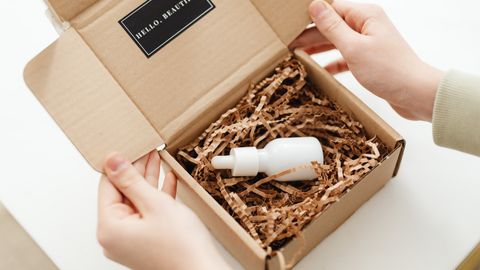
Use natural brown kraft as your default. It hides dust and handling marks, it reads as "paper" to almost every customer, and it suits most products. Choose white when the unboxing itself is part of what you sell: cosmetics, gifts, light-coloured products, and anything your customers will photograph.
Most buyers ask me this question as if one colour were better.
Neither is. Each colour does a different job in the box.
We make honeycomb paper in seven colours at our plant in Jaipur: natural brown kraft, white, black, blue, green, red and yellow. We sell it in widths from 100 mm to 500 mm and in grades from 50 to 120 GSM. Brown is still the one most buyers start with, and I think they are right to.
Why brown is the safer default
Brown kraft is forgiving. A packing bench is not a clean room. Hands are dusty, cartons shed fibre, and a roll gets bumped against a pallet on its way to the dispenser. On brown paper, almost none of that shows.
Dust is also why we wrap every roll as it comes off our line, whatever its colour.
Brown also tells the customer what the material is before they read a word. When someone opens a parcel and sees brown paper cells, they think "paper" and "recyclable". That is useful to you if you are moving away from plastic, because the wrap itself does part of the explaining.
The Wikipedia article on kraft paper gives the background: kraft pulp is naturally darker than other wood pulps, and it can be bleached to make very white pulp. Brown is simply the paper left as it is.
When white earns its place
White makes sense when the wrap is seen and judged, not just used.
- Cosmetics and skincare. White sits well next to white and pastel jars, and it looks clean in a photo.
- Gifts and hampers. White feels more "gift" and less "warehouse" to many customers.
- Light-coloured products with a matt finish, where you do not want brown dust near the surface.
- Brands with a white or monochrome look, where brown would clash with the box and the tissue.
There is a cost to white that has nothing to do with price. White shows everything.
A thumbprint, a grey smear from a dirty glove, a slightly different shade between two lots. If your packing area is dusty, white will tell your customer.
Brown or white at a glance
| Question | Natural brown | White |
|---|---|---|
| Hides dust and handling marks | Yes | No, shows them clearly |
| What the customer reads into it | Paper, recycled, practical | Clean, premium, gift |
| Shade differences between lots | Hard to spot | Easier to spot |
| Fits most products | Yes | Best with light, cosmetic or gift products |
| Needs a clean packing area | Helps, but forgiving | Yes |
| Long display or storage in light | Can darken or yellow over time | Bleached paper resists yellowing better |
On that last row, the same Wikipedia article notes that fully bleached kraft is used where strength, whiteness and resistance to yellowing matter. For a wrap that lives in a carton for a week, yellowing is rarely a problem. For gift sets that sit on a shop shelf under lights for months, it can be.
Does white cost more?
I will not quote prices here.
Paper prices move every month. The honest answer is that colour changes the base paper you buy, so ask for both colours on the same quote, at the same GSM, width and roll length, for example 80 GSM, 380 mm and 250 m flat. Then you compare like with like. We quote both colours that way when a buyer asks.
What I can say is that the real cost of colour often hides elsewhere. If white makes your packers slow down to keep it clean, or you add tissue to stop it marking, that is time and material on every order. Count it.
What about the brand's own colour?
Some brands want the wrap in their brand colour. We make black, blue, green, red and yellow as well, and they can look very good. But I would think twice before putting a strong colour against your product on every order. A bright wrap can make the product look smaller or cheaper next to it.
A simple rule I give brands: let the box and the label carry the brand, and let the wrap support it. On private label orders we print the buyer's design on the cartons and put the buyer's SKU codes on the roll labels, so the brand reaches the warehouse even when the wrap itself is plain. Our private label page explains how that works.
Three checks before you order a colour
- Lay a sheet of each colour next to your product, under daylight and then under your warehouse light. Take a phone photo of both. Look at the photos, not the paper, because that is what your customer's Instagram will look like.
- Ask one packer to wrap 10 orders in white without changing anything else. Then look at the wraps. If you see grey marks, clean the bench and gloves first, or stay with brown.
- Ask for samples from two different lots of the colour you choose. Put them side by side. If you can see the difference easily, your customers will too.
My own view
For a seller packing a wide mix of products every day, I would start with brown and add white only for the product lines where the unboxing matters. Two dispensers, two colours and one clear rule for packers will cover most businesses.
If you are not sure, run the three checks above with real samples. Our products page lists the colours, widths and grades, and our note on how much paper each order uses helps you size a trial.
Tell us your product and your packing volume on the contact page, and we will send brown and white at the same grade so you can judge them side by side.
Questions buyers ask
Is white honeycomb paper weaker than brown?
It can be, so do not assume either way. White paper can be bleached kraft or another white sheet, and the strength depends on how it was made and on its GSM. Test both colours at the same GSM, say 80 GSM, on your heaviest product.
Will brown kraft rub off on a white product?
Normally no colour transfers from dry kraft. What can happen is fine paper dust settling on a light, matt surface. If your product is white and matt, try a sheet of tissue between the product and the wrap, or use white honeycomb.
Can I mix white and brown honeycomb in one parcel?
Yes, and some brands do it on purpose, with white next to the product and brown outside it. Keep the rule simple for packers, for example "white touches the product, brown fills the rest", or the mix will look random.