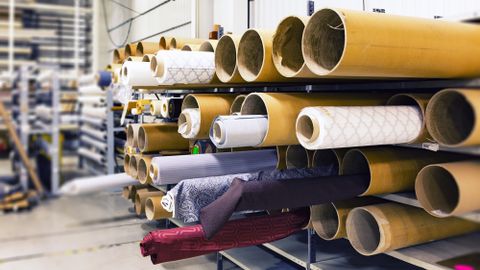
250 m, 100 m or 10 m: choosing a honeycomb roll length
Pick a honeycomb paper roll length by daily volume, lifting and storage: how long 250 m, 100 m and 10 m rolls last, what they weigh, and which suits whom.

The length of a roll looks like a detail.
It is not. It decides how often your packers stop to change rolls, how much a roll weighs on the way up to the dispenser, and how long an opened roll sits in your warehouse air.
Here is the short answer. Choose 250 m flat if you pack every day on a dispenser. It is the trade standard, it means the fewest roll changes, and it carries the least core and wrapping per metre. Choose 100 m for low daily volume, hand use, lighter lifting, or storage that is tight or damp. Keep 10 m rolls for samples, trials and retail packs.
We make all three in Jaipur.
Every length we quote is flat, i.e. the paper as it sits on the roll. With our cut, 1 m of flat paper opens to about 1.6 m of wrap.
The three lengths side by side
The weights below are for paper only, on a 380 mm roll of 80 GSM paper, worked out as GSM × width in metres × length in metres. The core and wrapping add a little on top.
| Flat length | Opened length at our 1.6x | Paper weight, 380 mm at 80 GSM | Best for |
|---|---|---|---|
| 250 m | about 400 m | 7.6 kg | Daily packing on a dispenser, warehouses, 3PLs, export |
| 100 m | about 160 m | 3.0 kg | Small shops, a few parcels a day, hand use |
| 10 m | about 16 m | 0.3 kg | Samples, trials, retail resale, occasional fragile parcels |
How many days will one roll last?
Work it out before you choose. The formula is short:
Days per roll = flat metres on the roll ÷ (flat metres per order × orders per day)
Flat metres per order is something you measure on your own bench. Our guide to honeycomb paper consumption shows how. For the table below, I have assumed 1.2 flat metres per order. It is an example figure, not a standard.
| Orders per day | 250 m roll lasts | 100 m roll lasts | 10 m roll lasts |
|---|---|---|---|
| 20 | about 10 days | about 4 days | about 8 orders |
| 100 | about 2 days | less than 1 day | about 8 orders |
| 400 | about half a day | about 80 orders | about 8 orders |
Look at the bottom row. At 400 orders a day, a 100 m roll runs out every 80 orders. That is several roll changes per packer per shift, each one a small stop in the line.
I like a roll on a busy station to last at least a full shift.
If it does not, go longer, or add a second station.
A worked example at the small end
Picture a jewellery seller in Melbourne who ships 15 orders a day, using about 0.5 flat metres per order. That is 7.5 m of paper a day.
- A 250 m roll lasts about 33 packing days. It stays open on the bench for more than a month.
- A 100 m roll lasts about 13 packing days.
- A 10 m roll lasts barely more than a day.
For this seller, I would suggest 100 m rolls by hand, or 250 m rolls on a small dispenser if the packing room is dry. A roll that sits open for a month in humid air is not the end of the world, but paper takes moisture once its wrapping comes off. Our guide to storage and humidity explains what that does to the cells.
Does the roll behave differently as it gets smaller?
It can, and few buyers expect it. The explanation is simple mechanics.
Take a dispenser that brakes the spindle. When the roll is full, the paper leaves from a large diameter. Near the end, it leaves from a small one. With the same brake setting, the packer has to pull harder on a small roll to turn it, because the paper now works at a much smaller radius. Think of a charkhi near the end of the manjha: the same grip feels much tighter when there is little string left.
So a brake that is perfect on a full 250 m roll can start tearing paper on the last few metres. If your packers complain about tears only near the end of rolls, ease the brake a little at that point. Longer rolls show this more, because the change from full to empty is bigger. One option is to set the brake on a half-used roll, as a middle point, and check it again near the end.
What about the dispenser and lifting?
A longer roll is a wider roll in diameter. Check your dispenser takes the full diameter before you move from 100 m to 250 m. Our core and roll diameter guide shows how to measure it.
Weight matters more for wide, heavy grades. A 250 m roll at 500 mm and 120 GSM carries 15 kg of paper. Someone has to lift that onto a spindle several times a week. Our roll weight chart has every combination.
Why is 250 m the export standard?
Because pallets and containers are planned around it. Our export roll is 380 mm x 250 m flat. We pack 40 of them on a pallet, so a 20 ft container takes 20 pallets or 800 rolls, and a 40 ft container takes 40 pallets or 1,600 rolls.
Shorter rolls ship the same paper with more cores and more wrapping per metre.
For an importer paying ocean freight, that overhead is paid for in every container.
If a distributor needs 100 m or 10 m packs for its own small customers, they can travel in the same container. In a mixed container, I would plan at least 4 pallets per item, so each line ships in sensible quantities. Our export page explains the loading.
Where we fit
We make 250 m, 100 m and 10 m rolls, all flat, in grades from 50 to 120 GSM.
I will admit the 10 m roll is not a working-line product, even though we manufacture it. It is very useful for a trial or a retail shelf. On a packing bench it runs out so fast that packers spend more time changing rolls than wrapping.
Tell us your orders per day and the paper you use per order through our contact page, and we will suggest a length. If you are unsure, start with a few rolls of two lengths and let the line decide.
Questions buyers ask
Can you make lengths other than 250 m, 100 m and 10 m?
Ask us with your dispenser size and volume. We will confirm on the quote whether a different length is possible. Before you ask, check that the longer roll will still fit your dispenser, because length adds diameter.
Is a 250 m roll too heavy for one person to lift?
Usually not. A 380 mm roll of 80 GSM paper carries about 7.6 kg of paper plus its core. A 500 mm roll of 120 GSM carries about 15 kg, which is a different matter at shoulder height. Keep spare rolls on a shelf at waist height, not on the floor.
Are shorter rolls more expensive per metre?
Usually, yes. Every roll needs its own core, its own wrapping and its own handling, whether it holds 10 m or 250 m. Compare quotes per flat metre at the same GSM and width, never per roll.
Should a distributor stock all three lengths?
Only if its customers really ask for them. I would start with the 250 m roll for business customers and add 100 m or 10 m packs once there is real demand from smaller sellers. Every extra length is another stock line to count and keep dry.