Honeycomb padded mailer sizes: what fits in each, M1 to M6
Honeycomb padded mailer sizes from 6x9 to 15x19 inches, in millimetres too, with a simple way to check what fits and which two or three sizes to stock.
Our honeycomb padded mailers come in six sizes: M1 6x9, M2 9x11, M3 10x13, M4 11x15, M5 12x16 and M6 15x19 inches. To check what fits, add your product's thickness to its length and to its width, and compare the result with the space inside the mailer, which is always a little smaller than the size printed on the box.
Most sellers do not need all six.
Two or three sizes usually cover most of their orders.
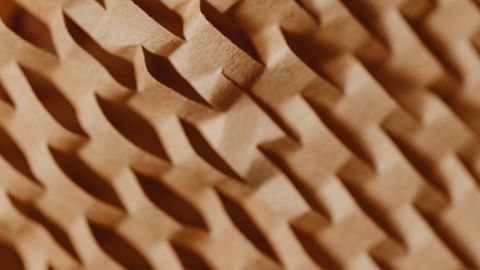
We offer these mailers alongside the honeycomb paper rolls we make in Jaipur. The padding is honeycomb paper, not plastic bubbles.
Here is how I would choose sizes if I were stocking them for an online shop.
The six sizes in inches and millimetres
| Our code | Size (inches) | Size (mm, rounded) | Worked examples of what may fit* |
|---|---|---|---|
| M1 | 6 x 9 | 152 x 229 | Phone case, slim jewellery box, A6 notebook, small boxed cosmetic |
| M2 | 9 x 11 | 229 x 279 | A5 notebook or diary, a few cosmetic boxes together, small accessories |
| M3 | 10 x 13 | 254 x 330 | Thin A4 documents and catalogues, a slim book, a folded scarf |
| M4 | 11 x 15 | 279 x 381 | A4 book, folded T-shirt, a set of prints |
| M5 | 12 x 16 | 305 x 406 | Folded shirt or light knitwear, larger books, a flat gift set |
| M6 | 15 x 19 | 381 x 483 | Folded hoodie or jacket, larger prints, bundled soft goods |
*These are examples worked out on paper, not promises. A thick product can fail to fit a size that looks big enough on this table. Always test with a real product.
I give millimetres too, because our export buyers work in both systems, and a mix-up here can cost you a whole consignment of the wrong size.
How do I check if my product fits?
A flat envelope does not stay flat when something is inside.
As the product goes in, the mailer bulges, and it loses length and width to that bulge. The thicker the product, the more it loses.
So use this rule of thumb:
- Measure your product: length, width and thickness.
- Add the thickness to the length. Add the thickness to the width.
- Add a small margin, so the product slides in without forcing.
- Compare with the inside size of the mailer, not the outside size.
Worked example: an A5 notebook is 148 x 210 mm. Say it is 15 mm thick. That gives about 163 x 225 mm before any margin. An M1 (152 x 229 mm on the outside) is clearly too narrow. An M2 (229 x 279 mm on the outside) leaves room. So M2 is the one to test.
Ask your supplier for the inside size of each mailer in writing. The padding and the seal flap both take space, and that space differs between designs.
Which two or three sizes should I stock?
Take your last 100 orders and write down which products went into each. Then group the products by the smallest mailer that fits each one. You will usually find that two sizes cover most orders, and a third catches the awkward ones.
Stocking all six sounds safe, but it fills your shelves and confuses inexperienced packers. Every extra size is another box to reorder and another chance to pick the wrong one.
There is one more reason to keep it tight. A product that rattles around in a mailer two sizes too big is not well protected. The padding works best when it sits close to the product.
Does the mailer size change postage?
It can, and this is worth checking before you choose. Postal services price by size bands as well as weight.
For example, the US Postal Service's own mailing standards (USPS Domestic Mail Manual, section 101) treat a "flat" (large envelope) as no more than 15 inches long, 12 inches high and 3/4 inch thick. A flat-size piece that is not uniformly thick, or goes over those limits, is treated as a parcel and pays parcel prices.
A padded mailer with a product inside is rarely uniformly thick. So in practice, plan for parcel rates in the US, and check your own carrier's size bands in other countries.
Your postage may matter more than the mailer itself.
What should not go in a honeycomb mailer?
I will be honest about the limits. A padded mailer protects against scuffs, bends and ordinary knocks.
It is not a box.
- Glass, ceramics and anything that cracks. Wrap these in honeycomb paper and ship them in a carton.
- Liquids. A leak soaks paper padding, and the whole parcel suffers.
- Heavy items with sharp corners. A corner can punch through on a hard drop.
- Very thin electronics that bend easily. A rigid board inside the mailer, or a small box, is safer.
For those products, our guide to how honeycomb paper protects a product explains wrapping in a box instead. If you are weighing these against plastic bubble envelopes, read our honeycomb versus bubble mailer comparison.
A five-minute fit test
- Pick your three most common products.
- Put each one into the two sizes you think will work.
- Close the flap. It should lie flat without strain on the seal.
- Shake the mailer. The product should move a little, not slide end to end.
- Drop it once from waist height on its corner, then open it and look at the product's corners and edges.
You will know your sizes in five minutes, and you will have a good reason to stop guessing.
Our products page has the mailers alongside our honeycomb rolls. If you send us your product sizes through the contact page, we will suggest the two sizes I would test first and send samples of those.
Questions buyers ask
What do mailer numbers like
They are a trade habit, not a standard I can point you to, and the inches behind the same number can differ between makers. I would always order by inches or millimetres, and ask for the inside size in writing.
Are honeycomb padded mailers waterproof?
No. They are paper, so a long wait on a wet doorstep can soften them. For most deliveries this is not a problem, but if your couriers leave parcels outside in the rain, test one first or keep a few plastic-lined options for those routes.
Can customers reuse a honeycomb mailer?
Often yes, if they open it carefully along the top. You could add a small "reuse me" line to your shipping label. It costs nothing, and it tells the customer you thought about it.
How much bigger than the product should the mailer be?
Enough that the product slides in without forcing and the flap closes flat. In practice, add the product's thickness to its length and width, then leave a small margin. Too much spare room lets the product move about, which defeats the padding.