Packing cosmetics and skincare with honeycomb paper: jars, droppers and pumps
Pack skincare and cosmetics for courier: lock pumps, secure droppers, protect glass jars, keep retail cartons unscuffed, and spot dangerous goods.
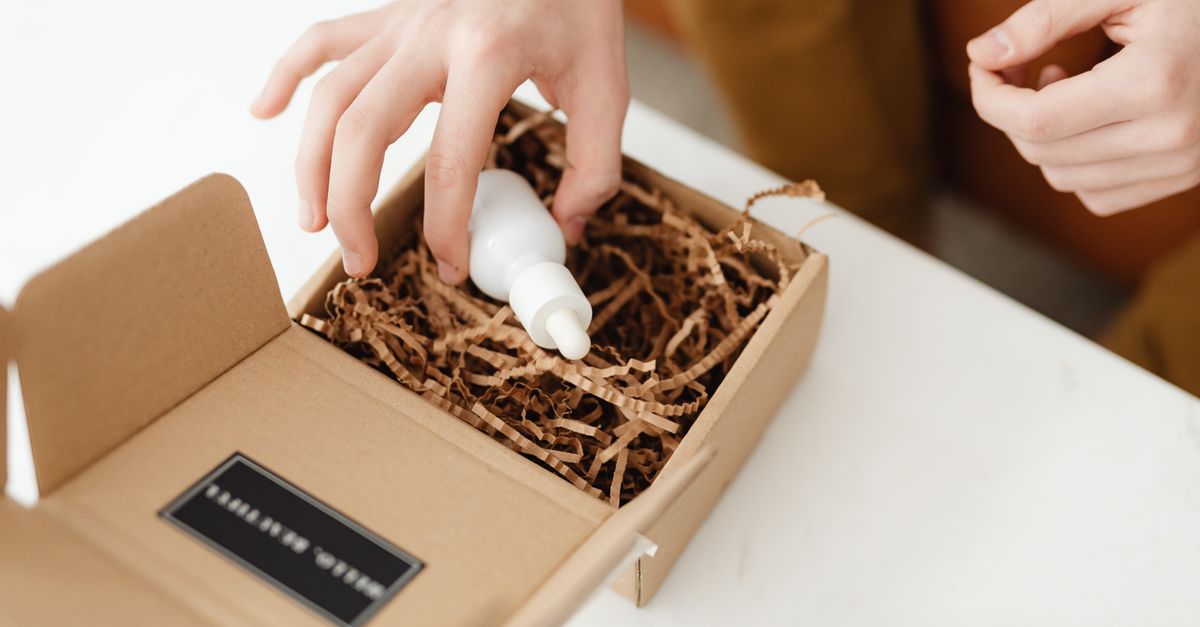
A cosmetics order can arrive unbroken and still disappoint. The serum leaked into its box, the compact rattles, or the retail carton has a scuff that makes it look second-hand.
To pack cosmetics for shipping, deal with closures first, then cushioning, then appearance. Lock pumps, screw dropper collars down and tape them, tape jar lids, and bag anything liquid. Wrap glass jars and bottles in two turns of honeycomb paper, give compacts extra padding, and put a sheet of tissue between a glossy retail carton and the honeycomb. Before the first order, check whether any product is a dangerous good for your courier.
Beauty products are light and mostly small, which makes people pack them lightly. In my view, that is exactly the mistake.
What goes wrong with cosmetics in a parcel?
Three things, in roughly this order of frequency for most skincare brands.
- Leaks. Pumps get pressed, dropper bulbs get squeezed, and jar lids loosen.
- Breakage. Glass jars, glass dropper bottles and the pressed cake inside a powder compact.
- Scuffs and dents on the retail carton, which the customer sees before the product.
The third one sounds cosmetic, and it is.
In this category, I would argue, cosmetic is the product.
How do you stop pumps and droppers leaking?
Close or lock every dispensing part, then put a second barrier over it.
We make honeycomb paper, and I still say this plainly: paper of any kind does nothing against a leak. The honeycomb comes later.
- Lock the pump. Most lotion pumps twist down and lock. If yours does not, a plastic clip or a strip of tape across the pump head stops it being pressed by a neighbouring item.
- Screw the dropper collar down firmly and run tape around the joint between collar and bottle.
- Tape the lid of every cream jar. If the jar has an inner disc under the lid, make sure it is in place.
- Put every liquid or cream in its own small sealed bag.
I would pack bottles upright wherever the box allows. A pump on its side has fluid against the seal for the whole trip.
How much honeycomb paper does each product need?
Match the wrap to the material, not the price of the product. Here is where we would start.
| Product | Main risk | How to wrap |
|---|---|---|
| Glass cream jar, 30 to 100 ml | Cracks against other jars | Two turns of 80 to 90 GSM, extra fold over the lid |
| Glass dropper bottle | Snaps at the neck, bulb leaks | Bag upright, two turns, extra paper around the neck |
| Pump bottle, glass or plastic | Pump pressed open | Lock and tape the pump, then two turns |
| Pressed powder or eyeshadow compact | The cake cracks from a knock | Keep flat, two turns, and keep it away from hard items |
| Plastic tube or bottle | Rarely breaks, can split under pressure | One turn of light wrap, mainly to stop rubbing |
| Lipstick or balm stick | Softens in heat, bullet snaps | One turn, packed lying down, kept out of hot vans |
For small boxed items, 60 GSM folds closely and is enough. For glass, 80 to 90 GSM gives you stiffer cells. Our GSM guide goes through the grades with metres per kilo.
How do you keep retail cartons looking new?
Use a smooth layer next to the carton and a snug fit in the outer box.
Honeycomb paper is textured, and on soft-touch or glossy retail cartons a rough wrap can leave rubbing marks on a long, bumpy route. A sheet of plain tissue between the carton and the honeycomb prevents that. On ordinary printed board, it is usually not needed.
The fit matters more than the wrap.
A carton that can slide inside the outer box rubs on every bump. Fill the space so it cannot move, and most of the scuffs disappear.
Colour is part of the brand here. We make honeycomb in white as well as natural brown, and our post on white or brown honeycomb paper compares them honestly. For single small items, a honeycomb padded mailer can replace a carton. We make them in six sizes, from M1 (6 x 9 inch) to M6 (15 x 19 inch), listed on our products page.
Which cosmetics are dangerous goods?
Some beauty products are classed as dangerous goods for transport, and paper wrap changes nothing about that.
Nail polish, nail polish remover, many perfumes, and other products with a high alcohol content are often flammable liquids. Aerosols such as hairspray and dry shampoo are compressed gas. Rules differ by courier and by country. As one example, the US Postal Service, in Publication 52, section 343, says flammable liquids are prohibited in air transportation and allows some only by surface transport in limited quantities.
So I would check the safety data sheet of every product, especially section 9 (the flash point) and section 14 (transport information), and then ask your courier before the first order. A lovely wrap on a refused parcel helps nobody.
Worked example: a three-step skincare set
Picture a skincare brand in Melbourne that ships a set of three: a 30 ml glass dropper serum, a 50 ml glass cream jar and a plastic cleanser tube. These numbers are only for illustration.
The serum collar is taped and the bottle is bagged upright. The jar lid is taped and the jar bagged. Both glass items get two turns of white 80 GSM honeycomb. The tube gets one light turn. The three stand side by side in a small carton with a roll of honeycomb between the two glass pieces, and void fill on top. When the box is shaken, nothing moves.
Then the brand does one more check. It puts a packed box on the floor with a 5 kg weight on top for an hour, to copy what happens at the bottom of a courier cage. If the retail cartons come out unmarked, the pack is ready.
Where honeycomb paper is the wrong choice
I see two cases. A product that must stay cool, such as some natural balms in summer, needs insulation, and paper is not insulation. And a very small loose item, such as a sample sachet, can slip through open cells, so put samples in a small bag or envelope first.
For bath products, see our separate guide to packing handmade soap and bath products. For diffusers and room fragrance, see packing reed diffusers.
If you tell us your bestselling three products and the carton you ship them in, using our contact page, we will suggest a colour, grade and width to try. We would rather you test our samples on your own products than take our word for it.
Questions buyers ask
Can I send a dropper bottle with the dropper fitted?
Yes, if the collar is screwed down firmly and the bottle travels upright in a sealed bag. A dropper is a weak closure, because liquid can sit in the glass pipette and the rubber bulb. For long or international routes, I would rather ship it with a plain cap and the dropper packed beside it.
Why do pressed powders break in the post even when the compact looks fine?
The pressed cake inside cracks from a sharp knock, and the case does not show it. Give compacts more cushioning than their weight suggests, keep them flat, and make sure nothing hard can hit them.
Is white or brown honeycomb better for beauty brands?
The protection is identical. White suits clean, clinical or pastel skincare. Brown suits natural and handmade brands. If the customer films the unboxing, I would test both next to your carton before deciding.
Do I need honeycomb if the product is already in a retail box?
Usually yes. The retail box protects the product on a shop shelf, not on a conveyor. Without a wrap and an outer pack, the retail box is what takes the knocks, and a dented retail box reads as a returned product.